Mishigami 2025
A race recap: 1,121 miles around Lake Michigan—my first bike race, my first ultra-endurance race, and a completely reasonable life choice.
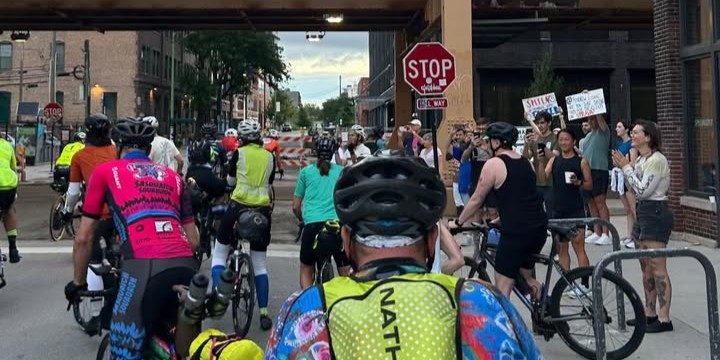
- The ride that changed everything
- The spark—and the midnight idea
- The buildup—gear & training
- Race prep—controlled chaos
- Day 1—the chase north
- Day 2—the Garmin crisis and the big sleep
- Day 3—the duel, the gas station floor, the breakdown
- Day 4—the final push
- What I learned
- The numbers
- 2026 optimizations
- Thank you
The ride that changed everything
In 2024, my proudest ride was a ridiculous, day-long adventure across four states. I mapped a 400-mile loop touching Illinois, Indiana, Michigan, and Wisconsin just to see how far I could go in 24 hours. That ride lit something in me.
Every year, I try to complete my age in cycling centuries before my birthday. In 2024, I hit 25 before turning 25. For 2025, I wanted something equally poetic and equally unhinged.
My first idea: run 26 marathons before my 26th birthday. Clever, right? 26 marathons for 26(.2) years. But cycling is my real obsession, and I still wanted a big bike goal. So I posted on Reddit looking for other cyclists with equally questionable judgment. Someone replied: "Have you heard of the Mishigami Challenge? Or the Chicago Randonneurs?"
I looked it up. 1,121 miles around Lake Michigan. Self-supported. No crew. No sleep unless you find it yourself.
The marathon goal was quietly shelved.
The spark—and the midnight idea
I went to the first Chicago Randonneurs meeting and met the 2024 winners, Tim Falkenberg and Sarah Rice. Hearing their stories made the distance feel both terrifying and magnetic. They talked about the route, the weather, the sleep deprivation, the hallucinations, the strategy—and the FKT.
The fastest known time.
That phrase stuck like a splinter. A few nights later—around midnight, when all my genius ideas seem to appear—I thought: wouldn't it be funny if I tried to break the FKT?
I opened Strava and pulled every ride over 100km from 2024. I calculated moving speed, elapsed pace, downtime ratio. I wanted to know if the FKT was even remotely realistic. That's when the uncertainty kicked in.
I had never been more than 70 miles away from home on bike. I hadn't touched my bike all winter. My first 100km ride of 2025 left me exhausted. My first 100-miler of 2025 left me dead.
But the idea had already taken root. And once it did, there was no going back.
The buildup—gear experiments and rebuilt fitness
My average power had dropped about 12% from 2024. In Chicago's flat terrain, power translates directly to speed—so rebuilding my ceiling was priority one. The spring became one long experiment, split between training and gear.
Gear
I went from 28mm to 32mm tires for comfort and tried the GP5000 S TR for lower rolling resistance. In training, I ran 32mm GP5000 S TR tires front and rear. For race day, I kept the 32mm setup but switched to a GP5000 S TR in the front and a GP5000 AS TR in the rear. I'd gone through two S-variant rear tires from punctures during prep, but never the AS. Eliminating mechanical delays mattered more than marginal gains, so I chose the more durable rear tire while still taking the slight rolling-resistance advantage up front.
I learned to wax my chain—spoiler: it worked beautifully; my drivetrain was spotless at the finish line. I mounted aero bars for the first time, which gave me extra positions but required real brain training to actually use in windy conditions instead of defaulting to the hoods. And I tested a third-bottle setup to stretch my refuel intervals to around 180km, reducing stops and keeping my elapsed pace more consistent.
A key distinction between me and a lot of other riders was how light I packed. Plenty of people carried multiple kits, top-tube bags, frame bags, even full handlebar setups. I focused on being minimal. In my 400-mile ride, I basically carried tools and two bottles and survived just fine—so I knew that if I needed more during the race, it was probably worth taking a real stop rather than hauling extra weight for 1,100 miles.
Training blocks
My structure alternated high-volume weeks with recovery weeks capped by one long effort—three 100km rides one week, a single 300km the next. As race day got closer, I shifted toward fatigue resistance: riding long, back-to-back days to train my body to keep working under exhaustion.
The two key blocks were what I called Metric Century Week (seven consecutive days of 100km rides) and American Century Week (seven consecutive days of 100-mile rides). Those hurt the right way.
I also tried a 400-mile training ride to simulate race conditions. A tornado and hailstorm warning ended that one. The longest I completed was about 300 miles at roughly 19.5 hours. Going beyond 24 hours straight remained unknown territory heading into race day.
On nutrition, the big discovery was Trolli Gummy Worms—easy to pack, easy on my stomach, excellent race fuel. I never fully locked down a complete strategy, but I at least learned what upset my gut.
Race prep—controlled chaos
Race day was July 12th. Two days before, the anxiety hit. Not the "I'm nervous" kind. The "I'm about to ride farther than I've ever been from home and if something breaks 300 miles away, I'm cooked" kind.
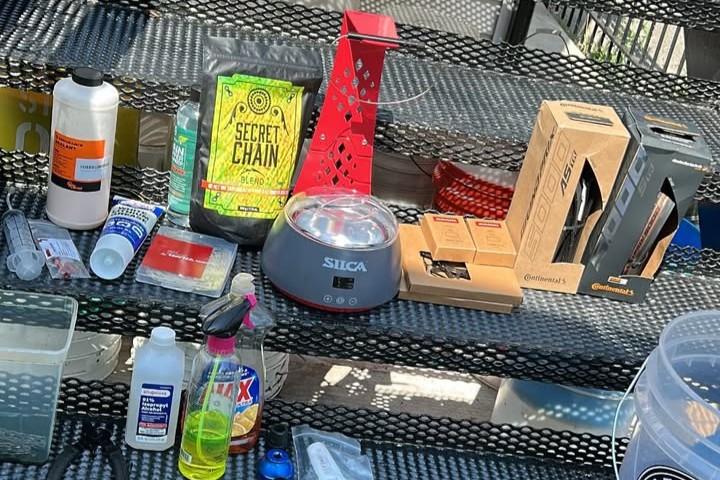
The full-day mechanic's exam.
I only own one bike: a gloss-red Specialized Roubaix Comp 2022. I spent all of July 10th doing maintenance—learning to wax a chain, installing a new chain, servicing the wheel hub, mounting new tubeless tires, charging every electronic component I owned, replacing brake rotors and pads. A full-day mechanic's exam.
July 11th was the pre-race meeting. We got our official cycling caps. I was number 19. As soon as it ended, I rushed to Menards because I'd completely forgotten reflective stickers. Got home, stuck them on, sat down to sleep—and realized I hadn't packed my bike bags.
What followed was a midnight packing spiral: electrolytes, tools, chargers, nutrition, spare parts. By the time I felt reasonably good about it, it was 3am. I needed to wake up at 5am.
Those were the best two hours of sleep of my life, in the sense that they were the only two hours before a four-day race.
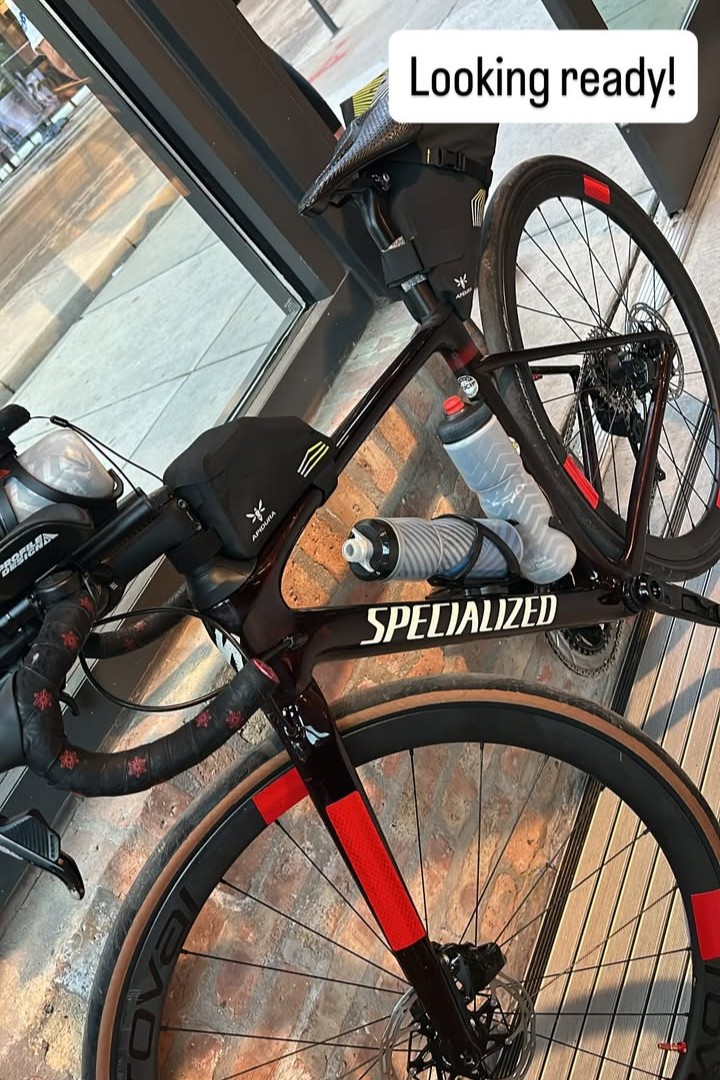
The last time it looked this clean.
I drove to the start, unloaded everything, and immediately discovered my saddle bag sagged so badly the radar was nearly touching the tire. I arrived with no time to spare, scrambled for some pre-race photos, and stepped outside to find about 30 riders ready to go.
Before I could think about positioning, I noticed my tracker wasn't on. I stopped a few seconds after the start to fix it. By the time it was working, every rider had disappeared. I was dead last. Three miles behind the next person. Great start.
Day 1—the chase north
The Lakefront Trail gave me a chance to ease in and slowly work back toward the pack. The first rider I caught was Kim, a fellow Chicago Randonneur. We chatted on the way toward Wisconsin until a small collision between us sent me embarrassingly to the ground—road rash on the shoulder, bruised ego, nothing major.
I said farewell to Kim to stay on pace and put my head down. My fear going in was blowing up too early. So I held my plan: controlled effort, consistent pace, let the race come to me. It worked.
Mile 114 I caught Tim Falkenberg—the 2024 winner—dealing with stomach issues.
Mile 130 I overtook Peter Monko and Andrew Backer. Suddenly I was in podium territory. Only Isaac Scott and Justin Grant were ahead, running neck and neck about 15 miles up the road. My theory: their pace wasn't sustainable, or that if it was, I wouldn't be able to match it anyway. I held mine and waited.
One thing I didn't account for: a generous tailwind pushing us north the whole way. In hindsight, I should have pushed a little harder to bank time. Lesson filed.
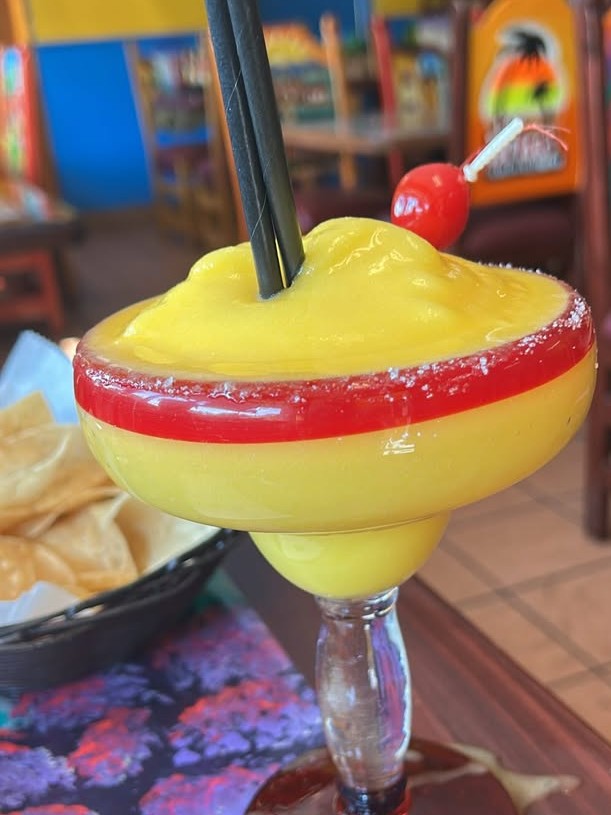
A delicious mistake.
Mile 200 I stopped at Las Brisas in Sheboygan for a full sit-down meal. This was a mistake. A delicious mistake, but a mistake. The hour-long stop—which included a frozen margarita, frozen not on the rocks, which takes significantly longer to finish—cost me five positions. Sarah Rice, who had been 10 miles back, caught up. Rookie move number one.
Mile ~250 Riders started clustering and resting. I rode alongside Sarah Rice and Peter Monko into Green Bay. My strategy from the start had been to ride all the way to St. Ignace without sleeping—straight through the night. So while others took proper rest, I kept moving and bumped myself up to 4th.
Mile 300 Isaac and Andrew took extended breaks. I moved into 2nd, with only Justin ahead.
Mile 340 Twenty-three hours in, chilly and dewy and sleepy, I pulled over near a secluded road by what I can only describe as a weird brick shed. I used my saddle bag as a pillow on the wet grass, and took what was supposed to be a 15-minute power nap. It turned into 20. Still counts.
First nap spot. Still no idea what it is.
Day 2—the Garmin crisis and the big sleep
Mile 434 I stopped at a NAPA AutoCare Center and used their outdoor vending machine with my, one and only, $5 bill. That Dr. Pepper, cold against the scorching sun after 30 hours of riding, was one of the best drinks of my life.
Mile 450 My Garmin was dying. I had two battery banks—one that used USB-A cables and one that used USB-C—but my Garmin charges via Micro-B. The only Micro-B cable I had was USB-A to Micro-B, and the USB-A bank was already dead. No way to charge it. No Garmin meant no navigation and no Strava proof of the race. And if all those USB terms were confusing, the short version is: I basically had no way to charge my Garmin.
Mile 466 While eating pepperoni pizza at a rest stop, I had a eureka moment: buy a new battery bank at a gas station and gamble on it having enough charge to reach the hotel. It worked.
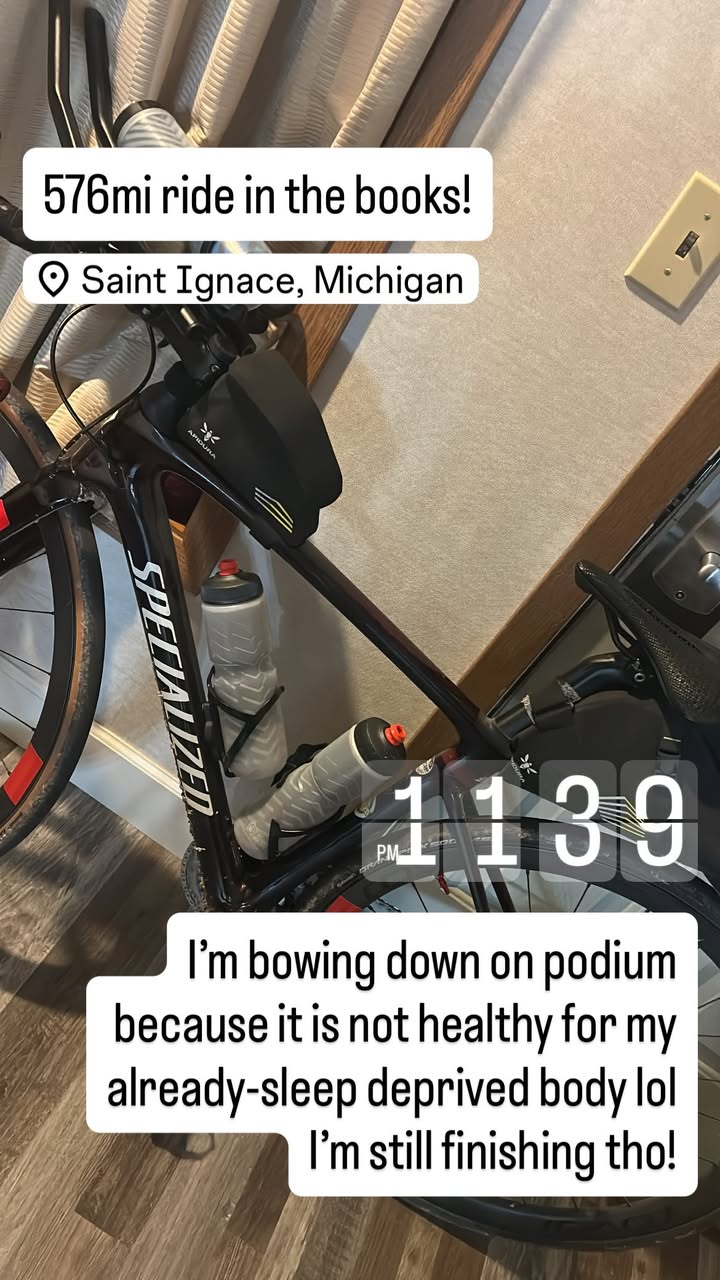
576 miles down. Bowing to podium.
The final stretch to St. Ignace was a slow grind—subtle uphill, racing sunset, genuinely worried my headlight would die. I made it to the hotel just before the Mackinac Bridge crossing.
Forty hours in on two hours of sleep, I was hallucinating. I planned to stay three to four hours. I showered, looked at the bed, and made a different decision: I gave up on podium and slept without an alarm. Midnight to 8am.
I woke up expecting disaster. I was still in 4th. Andrew was 20 miles ahead. Isaac was 45. Justin over 100.
"Twenty miles? We can totally close that."
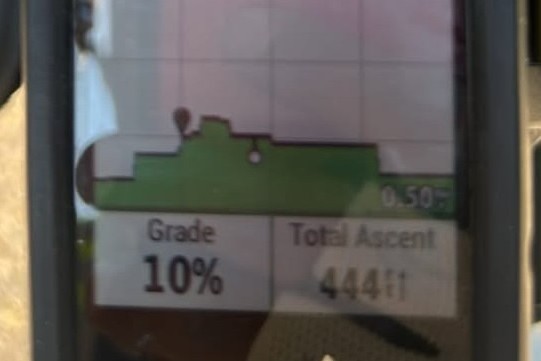
My first ever 10% grade! Brutal.
I ate breakfast, packed up, and started fighting the headwind south. Then came the hills. Real hills. Chicago is flat—I rarely see anything above 5%. Heading down from the UP, I hit my first ever 10% grade and a 452-foot climb. With fatigued legs, I had to figure out on the fly how to pace a real climb using a 33T chainring I'd never properly used. Welcome to the course.
Mile 638 Just past Charlevoix, I caught Andrew Backer on a slight climb. I was so locked in I didn't realize it was a fellow racer until I reloaded the tracker.
Day 3—the duel, the gas station floor, and the breakdown
Mile 770 I finally met Isaac at Frankfort in a spiky climbing section. We chatted, truced for a bit. He mentioned he'd be stopping at Manistee to sleep. I—in what I now recognize as a classic rookie mistake—openly shared my strategy: no sleep, straight to the end.
We split just before Manistee. I relaxed. Then I reached Ludington and checked the tracker.
His dot was still moving. He hadn't slept. He was chasing me.
Mile ~830 Ludington was supposed to be a quick stop at Wesco. But their tap-to-pay wasn't working. I had no physical card. My last cash was $2.50. It was 1am in a small town with nothing else open.
So I did what any reasonable, extremely sweaty, sleep-deprived cyclist lying on a gas station floor would do: I asked strangers to pay for my food and offered to Zelle them back. A man fueling up his car helped me out—apparently I looked too disheveled to be making it up. What should have been 10 minutes became an hour. Isaac closed his gap from 15 miles to 5.
My rear derailleur battery also died during this stop. I swapped it with the front battery. I hadn't brought the charger. Filed under things I won't forget next time.
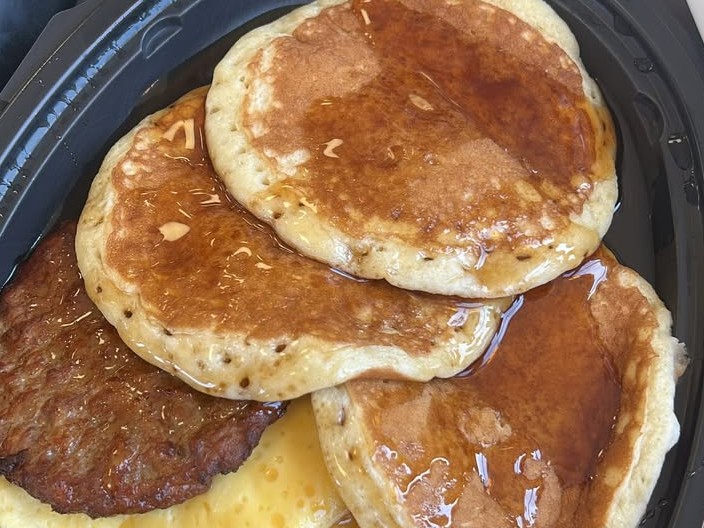
Excellent carbohydrate loading.
Isaac chased until he finally rested at a hotel in Pentwater. I pushed another 5 miles, found a bench around mile 860, and intended a 30-minute nap. The cold stretched it to an hour. I went to Burger King, got pancakes, poured every packet of syrup on them, and told myself this was excellent carbohydrate loading. It might have been. It definitely made me happy.
The second day south was the hardest. Brutal headwind, a genuine heat wave, sun without mercy. I also discovered that you can sunburn your lips. I did not previously know this. I'm Mexican and, before 2024, I rarely spent long hours in direct sun, so sunburns and sunscreen were never really part of my life.
Mile 909 My sleep-deprived brain turned into a driveway instead of the actual turn. I U-turned, hit sand, went down on my left forearm. Another bruise. Getting into the aero bars became painful for the rest of the race.
Five miles of nothing but trees. Not even a good nap spot—overgrown grass and crawling insects.
Mile 982 I broke. A five-mile stretch of nothing but trees. Low on water. Heat. Wind. Bruised arm. Isaac closing in from about 30 miles back. I stopped. I shed a few tears. I seriously considered calling it.
I'd already more than doubled my personal distance record. I was bruised and severely sleep-deprived. But I pedaled to the next rest stop. Slowly, but I pedaled.
Day 4—the final push
Mile 1,001 Near Benton Harbor, a boat crossing blocked the road just as I stopped at a gas station. Isaac was 25 miles back. I took it as a sign, sat down, and got a proper power nap. I woke up feeling, somehow, revived. Isaac was 20 miles back. About 120 miles left.
"Easy work."
For the next 40 miles I raised my average speed by a full mile per hour. I wanted a buffer—a gap large enough that I could afford another nap if needed. It grew from 20 to 30 to 40 to a maximum of about 45 miles.
Last nap spot! Here's a map of all my nap spots (that I recall).
With 20 miles left, I played one final psychological move—payback for the fake Manistee sleep—and took a deliberate 20-minute nap to give Isaac false hope. When I woke up, my derailleur battery was critical.
I rolled onto the Lakefront Trail slowly, trying to actually absorb what I'd just done. Then I noticed cameras. A car following me. I was confused—I hadn't told many people about the race. My family is small. My parents run a flower shop and work long hours. I wasn't expecting anyone at 1:30am on a Wednesday.
It was Jack Peck, the event organizer, and Victor Hilitski, the photographer. They had been waiting for me. I had never had anyone at a finish line before. It meant more than I expected.
I finished the last miles, got a little lost downtown, found the finish, and hit pause on my Garmin as it died. My derailleur battery died at exactly the same moment.
Almost scripted. A few minutes longer on that last nap, and I might not have made it with a working device or the ability to shift gears. But I made it.
2nd place overall. 1,121 miles. My first bike race. My first ultra-endurance race.
What I learned
The numbers (for the spreadsheet people)
Before committing to anything, I needed to know whether chasing the FKT was a real goal or just a midnight delusion. So I pulled every 2024 ride over 100km from Strava and ran the numbers.
The three metrics I cared about: moving speed (actual pedaling speed), pace (distance divided by elapsed time, stops included), and downtime ratio (stopped time divided by elapsed time). The useful thing about downtime ratio is that it tends to improve over longer distances—each stop costs proportionally less of your total clock as the ride gets longer. Convenient math.
2024 training data
| Threshold | Data Points | Moving Speed | Pace | Downtime |
|---|---|---|---|---|
| ≥ 100 km | 30 | 18.1 mph | 16.23 mph | 10.16% |
| ≥ 100 mi | 22 | 17.9 mph | 15.9 mph | 11.28% |
| ≥ 200 mi | 3 | 17.4 mph | 15.46 mph | 10.96% |
Everest and Everest ROAM rides were excluded—obvious outliers, for obvious reasons.
What the table doesn't show is how power and heart rate shifted across distance. At shorter efforts around 65 miles, I averaged roughly 159 watts and 149 bpm. At century distance, that held at about 161 watts and 150 bpm. For the 200+ mile rides, it fell to around 149 watts and 139 bpm. The pattern was clear: my body naturally dialed back intensity as distance increased, even when I wasn't consciously pacing. The question was how far below that curve Mishigami would push me.
In total, those 2024 rides covered about 4,500 miles—22 centuries and 3 double centuries—across roughly 249 hours of moving time. The 400-mile ride in July was the standout: 22 hours and 57 minutes of moving time with only 9.6% downtime. If I projected that elapsed pace to 1,121 miles, it came out to roughly 71 hours—about 3 days. A useful anchor, but it assumed no sleep and no fatigue beyond what I'd already experienced.
I also didn't average blindly. Some of those data points were group rides or casual paces with no business being in race predictions. After filtering for actual effort context, my conservative floor estimate landed at 15 mph pace during any active riding interval, not counting time at a rest stop.
Those data points informed my initial predictions before I had any real training or baseline fitness metrics. I started with a 17 mph moving speed, applied a 0.25 mph decay per 80-mile split, and modeled different downtime ratios to understand how much rest I could afford without missing the FKT window. To support this, I built a pace calculator (example) to simulate various scenarios. A rough draft of my Mishigami plan is available in the examples directory for anyone interested in running their own projections. As the season progressed, I continuously refined both the model and my race strategy.
Plan vs. reality
My race strategy split the route into two halves: ride to St. Ignace, sleep, ride back to Chicago. The plan held together reasonably well—right up until sleep deprivation introduced variables my simulator hadn't modeled. That was around mile 340, hour 23.
| Prediction | Actual | |
|---|---|---|
| Elapsed time | 84h 30m | 91h 35m |
| Moving time | 72h 30m | 69h 30m |
| Sleep | 4h | ~10h |
| Naps | 0h | ~5h |
| Down time | 8h | ~8h |
| Down time ratioexcl. naps & sleep | 12% | 8.7% |
| Flats | — | 0 |
| Gummy Worms | — | ≥ 1,000 |
| Nap spots | — | Map |
Two key gaps between prediction and reality: I slept more than twice as long as planned, and I took unplanned naps throughout the race that the model never accounted for. The silver lining—sleep deprivation, the one variable I couldn't model, ended up being the biggest limiter. My actual moving time outperformed the prediction, and with a lower-than-expected downtime ratio, I likely had more room to keep pushing on the bike.
Overall the race went well. I'm confident that with proper sleep the night before, I could have closed the gap to Justin by at least four hours. But predictions only tell you what might happen. The body keeps its own ledger.
The body’s receipt
Racing is one thing. What happens after is another. I went back to the same Strava data that built my predictions and looked at 2025 as a whole—before, during, and after Mishigami—to see what the numbers actually said about the cost of riding 1,121 miles.
2025 training data
The 2025 season ran from March through December—49 tracked rides (over 100km) totaling just over 7,000 miles, a 58% increase over 2024. Century count jumped from 22 to 34; double centuries from 3 to 9. Average speed dipped from 17.4 to 16.9 mph, and average power dropped from 159 watts to 145. Part of that dip was deliberate—2025 was an endurance year, built around longer rides at lower intensity. But part of it was the cost of starting over. I hadn’t touched my bike all winter, and a significant chunk of the spring went toward rebuilding the baseline I’d built in 2024 before I could even begin to improve on it. That rebuild ate into the numbers.
It’s also worth noting that in 2025 I didn’t train or pace with power data at all. My power meter was on the bike, but I never looked at it during a ride. Every effort was paced entirely on feel. Looking back at the numbers now, I can see where structured power targets would have helped—but at the time, I was still learning what those numbers meant and how to use them.
| Threshold | Data Points | Moving Speed | Pace | Downtime |
|---|---|---|---|---|
| ≥ 100 miexcl. Mishigami 2025 | 33 | 16.9 mph | 15.0 mph | 11.8% |
| ≥ 200 miexcl. Mishigami 2025 | 8 | 16.5 mph | 15.5 mph | 11.2% |
What Mishigami did to my body
Over 69 hours and 33 minutes of pedaling, I averaged 101 watts and 126 bpm—both the lowest of any ride over 100 miles in either year. That 101-watt average was 31% below my pre-race century average of 147 watts. My power meter died around hour 80, so the true average across the full race was likely even lower.
The heart rate tells the real story. At 126 bpm I was riding well within my aerobic ceiling, and the pacing felt disciplined in the moment. But duration changes the equation. Seventy hours in an elevated cardiac state accumulates stress in ways that a single hard century never does.
Garmin tracks this as HRSS—Heart Rate Stress Score—a cumulative measure of cardiac workload. A typical century in my data scores between 250 and 400 HRSS. My hardest non-Mishigami ride, the 403-mile effort in September, scored 1,108. Mishigami scored 1,961. That single ride accounted for 10% of my entire year’s training stress—roughly three to six weeks of typical load, absorbed in under four days.
The recovery arc
My first ride back was 17 days later: a 63-mile effort at 19.9 mph and 167 watts. It looked like I was fine. I wasn’t. My heart rate averaged 179 bpm—25% above my pre-race baseline for similar speeds. That’s not fitness. That’s adrenaline and a body running hot on short efforts.
The crash showed up over the next few weeks. By day 35, I was riding centuries at 15.7 mph and 125 watts—an 8% speed drop and 15% power loss from pre-race levels. Day 42 was the nadir: 15.3 mph, 117 watts, a 21% power deficit. My body had absorbed the stress of Mishigami and was still paying interest.
Recovery wasn’t linear. It came in waves. Day 49 brought a 250-mile ride back at baseline speed. Day 76 produced my fastest century of the year—a sub-5-hour hundred at 20.1 mph and 178 watts, a goal I’d been chasing all season—but it cost 169 bpm, a cardiac price tag that pre-race me wouldn’t have paid for the same output. By late October, power was still 7–8% below pre-race averages, and my heart rate per unit of speed had drifted upward.
In other words, I got the speed back eventually. But the efficiency behind it didn’t fully return in 2025. The 2024 projection said Mishigami would take about 72 hours. It took 91.5. That ~20-hour delta was the cost of going beyond anything my body had done—and the months after were the cost of having done it at all.
2026 optimizations
I'm not sharing every optimization this time—I've learned my lesson. But here are a few obvious gains that would've made the ride faster:
The people who made it real
The Chicago Randonneurs (literally everyone there) deserve the first mention. Joining that club exposed me to organized ultra-endurance riding, routes near Chicago with actual hills (yes, they exist), and a community of riders with genuinely questionable judgment about distance. That environment is what made Mishigami feel possible in the first place.
Jack Peck and Victor Hilitski were at the finish line—late at night, cameras ready, waiting. After four days of riding, that moment landed harder than I expected. I've never really had a finish line moment like that before. It's something I'll carry with me for a long time.
If you want to see what 91 hours of delusion looks like—or just admire my spotless waxed chain—check out Victor's finish line gallery.
For extra photos, videos, and commentary, check out the full Instagram highlight.
Maybe I'm making a mistake by sharing all of this so openly.
But hey—see you at the 2026 Mishigami Challenge!